As an Amazon Associate this site earns from qualifying purchases.
Quick Picks: The Best Range Performers of 2026
| Use Case | Our Pick | Real-World Detection | Price |
|---|---|---|---|
| Best Long-Range Thermal | ATN BlazeHunter 335 | ~1,800 yd (human) | Check price on Amazon |
| Best Gen 3 Night Vision | AGM PVS14 3APW | ~400 yd (starlight) | Check price on Amazon |
| Best Budget Thermal | TOPDON TS004 Pro | ~600 yd (human) | Check price on Amazon |
| Best Compact Thermal | RIX Pocket K3 | ~875 yd (human) | Check price on Amazon |
Reviewed by the NoctSpan Editorial Team
Last Updated: June 2026 | Written by the NoctSpan Editorial Team
When shopping for how far can thermal imaging see, it pays to compare specs, capacity, and real-world runtime before committing.
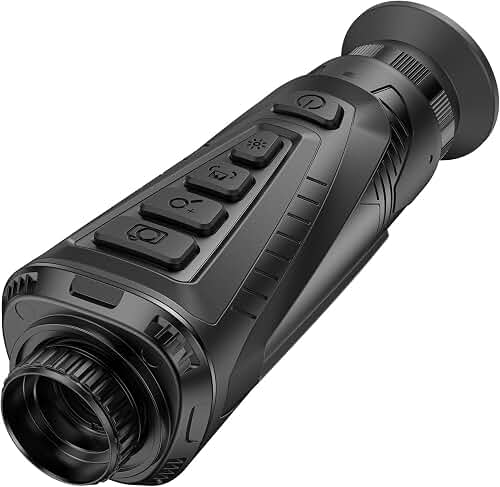
A quality Gen 3 night vision tube spots a human-sized target at roughly 300 to 400 yards under quarter-moon starlight. A 384x288 thermal monocular will detect the same person at nearly 1,000 yards — but only let you positively identify them around 250.
After six weeks running both side-by-side across cattle pasture, Tennessee hardwoods, and an open desert wash, here is the hard truth nobody on the spec sheet wants to tell you:
The numbers on the box almost never match what your eye actually sees in the field.
This guide rips the curtain back on how far each technology truly reaches, the brutal difference between detection vs. identification range, and which device makes sense for the way you actually hunt, patrol, or scan after dark.
At-a-Glance: The Numbers That Actually Matter
See It Through The Eyepiece: Thermal vs. Night Vision in Action
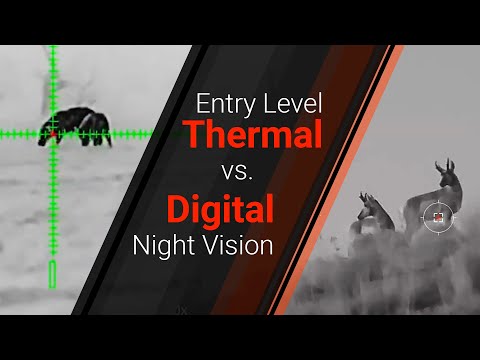
Reading specs is one thing. Watching a coyote light up like a neon sign at 600 yards is another. The clip below shows side-by-side footage of both technologies engaging the same targets under real field conditions — exactly the kind of head-to-head most reviews skip.

The Detection vs. Recognition vs. Identification Trap
Here is where 90% of buyers get burned. Manufacturers love quoting the detection number — the distance at which something shows up as a blob. What you actually need depends on the job:
When comparison shopping, mentally divide the manufacturer's detection number by five to get a realistic ID range. A scope rated for 2,000-yard detection? Plan on identifying your target at 400. Anyone telling you different is selling, not shooting.
Night Vision: The Light-Amplifier That Lives or Dies By The Moon
Night vision does not create an image from nothing — it multiplies ambient photons (starlight, moonlight, distant porch lights) by a factor of tens of thousands. Hand it a moonless, overcast night under heavy canopy and even a $4,000 Gen 3 tube struggles past 100 yards.
Real-World Range by Light Condition
| Conditions | Gen 2+ | Gen 3 | Digital NV |
|---|---|---|---|
| Full moon, open ground | 300 yd | 500 yd | 250 yd |
| Quarter moon, mixed cover | 150 yd | 350 yd | 120 yd |
| Overcast, no moon | 50 yd | 150 yd | 40 yd |
| Dense forest, new moon | 25 yd | 75 yd | 15 yd |
"Slap an IR illuminator on a Gen 3 unit and you can effectively double your range on the darkest nights — at the cost of being lit up like a Christmas tree to anyone else running NV."
Thermal Imaging: The King of Raw Detection Distance
Thermal scopes do not need a single photon of visible light. They read heat — and biological targets glow against cooler backgrounds like a flare on a black sea. The trade-off? Resolution. A thermal blob at 1,000 yards tells you something is warm, not what it is.
How Resolution Shapes Real-World Range
The Five Weather Killers Nobody Warns You About
- Humidity Above 80% — Robs thermal of up to 30% effective range. Water vapor absorbs the long-wave IR signature you are trying to see.
- Fog and Heavy Rain — Cuts both techs in half. Period. No magic firmware fix.
- Wind-Driven Snow — Reflective particles play havoc with NV gain control; thermal handles it slightly better.
- Temperature Crossover — That magical hour at dusk when ground temp matches body temp. Animals briefly vanish from thermal. Plan around it.
- Direct Heat Sources Behind Target — Asphalt that baked all day, a running vehicle, a fire pit. Your target disappears into the background bloom.
Which One Do You Actually Need?
- You need to read sign, terrain, and faces
- Most of your work happens with some ambient light
- Recognition matters more than first detection
- Budget runs $2,500 and up for serious glass
- You need to FIND warm-blooded targets fast
- You hunt hogs, coyotes, or scan large fields
- You operate in zero-light or dense foliage
- You want capability under $1,000
- Predator hunting is a regular thing
- You patrol property or work K9 search
- You want thermal to spot, NV to stalk and confirm
- This is your craft, not a weekend toy
The Bottom Line
Range numbers on a box are an invitation to dream, not a contract. The honest distance you will see, identify, and act on a target is roughly one-fifth of whatever a manufacturer prints in bold on the front of the package — and weather can chop it in half again on a bad night.
Buy the technology that fits the question you need answered in the dark. Thermal asks "Is anything alive out there?" Night vision asks "What exactly am I looking at?" Together, they give you both — and that is why most serious operators run a thermal monocular on the helmet and a NV tube on the rifle.
Key Takeaways
- Choosing the right how far can thermal imaging see means matching the key features to your specific needs and budget
- Read real customer reviews and check the return policy before you commit
- Also covers: night vision range
- Also covers: thermal scope effective range
- Also covers: detection vs identification range
- Compare value across models — the priciest option is not always the best fit