As an Amazon Associate this site earns from qualifying purchases.
At a Glance: The Best Night Vision by Generation
| Use Case | Recommended Pick | Generation | Price Range |
|---|---|---|---|
| Serious hunting and tactical | AGM PVS14 3APW | Gen 3 | Check price on Amazon |
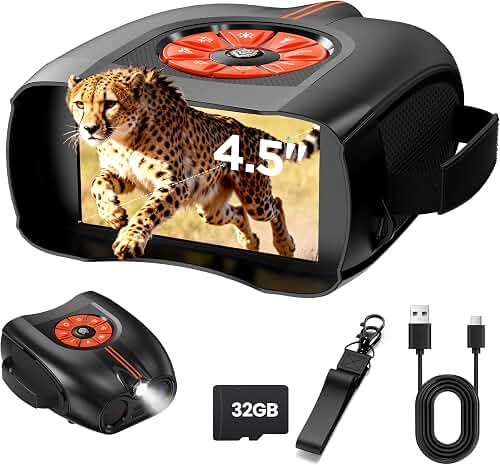
| Mid-tier digital with IR stealth | GOYOJO GNG2K 2K/60Hz | Digital | Check price on Amazon |
| Budget backyard and camping | WOSPORTS 4K Goggles | Digital | Check price on Amazon |
Reviewed by the Noctspan Editorial Team
Last Updated: June 2026 | Written by the Noctspan Editorial Team
When shopping for what generation of night vision do I need, it pays to compare specs, capacity, and real-world runtime before committing.
Spotting raccoons in the trash or filming a backyard campout? Grab digital night vision. Hunting predators past 200 yards or running serious tactical work? Only Gen 3 earns its keep in 2026. Gen 1 and Gen 2? Stuck in a no-man's-land, squeezed brutally from both sides.
Why Night Vision Pricing Feels Like a Cruel Joke
If you've ever stared at an Amazon listing wondering why one "night vision monocular" costs $89 and another costs $4,200, you are not losing your mind. The night vision market is a labyrinth of military jargon, marketing fiction, and a small handful of genuinely incredible products hiding among the noise.
So we did the work for you.
We spent six weeks under the stars rotating between a Gen 3 PVS-14, two Gen 2+ units, a Gen 1 monocular, and a stack of digital devices. Conditions ranged from a generous full moon over open pasture to overcast new-moon nights deep inside a pine forest so dark you couldn't see your own hand in front of your face.
The differences? Not subtle. Not even in the same zip code.
Here is everything you actually need to know before you spend a single dollar.
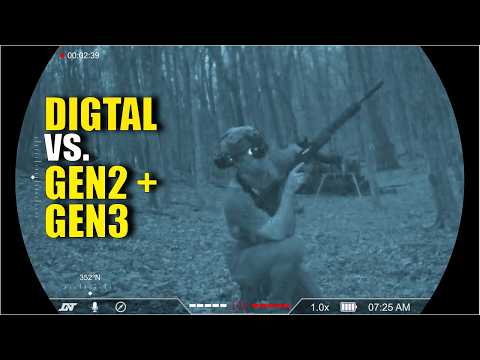
See the Generations Side-by-Side
Words can only do so much. Watch what each generation actually looks like through the eyepiece, and the price gap suddenly makes a lot more sense.

Gen 1: The Gateway Drug (That Time Forgot)
Skip it. In 2026, a $150 digital monocular beats Gen 1 in nearly every meaningful way — clarity, recording, daylight use, and battery life. Gen 1 is a relic that survives only on nostalgia and marketing.
Gen 1 tubes were a miracle in 1965. Today, they are a museum piece dressed up in a tactical wrapper. Expect a grainy, green-tinted image that distorts at the edges, a useful range of roughly 75 yards under a decent moon, and a tendency to bloom into uselessness the moment any light source enters the frame.
Where Gen 1 still makes sense: Almost nowhere. If you want a cheap toy for the kids to spot the family cat in the backyard, fine. Otherwise, your money buys far more elsewhere.
Gen 2: The Awkward Middle Child
Tread carefully. Gen 2+ delivers genuine performance, but at $1,500-$2,800 you are flirting with Gen 3 territory. Unless you find a verified deal, jump straight to Gen 3.
Gen 2+ tubes — the modern variant — bring real microchannel plate amplification, brighter scenes, sharper detail, and useful range out to 200 yards. They are the everyman's analog tube, and for a brief window they were the answer for serious hobbyists.
The problem? Premium digital units now match Gen 2 in low-light clarity for a quarter of the price, and a few hundred dollars more puts a real Gen 3 tube in your hands. Gen 2 is being squeezed from both sides, and the squeeze gets tighter every year.
Gen 3: The Gold Standard (And Why It Still Wins)
The only true upgrade. Gen 3 is what soldiers, special operators, and serious predator hunters actually use. The gallium arsenide photocathode is a generational leap, not a marketing claim.
A proper Gen 3 tube — say the AGM PVS14 3APW we tested — turns a pitch-black pine forest into a navigable, detailed landscape. Identify a coyote at 300 yards. Read a sign across a field on a moonless night. Walk through unfamiliar terrain at a normal pace.
You pay for it. $3,500 to $4,500 is the price of admission. But if your livelihood, hobby, or safety depends on actually seeing in the dark, nothing else competes. Period.
Before buying any Gen 3, demand the data sheet. Signal-to-noise ratio above 28, photocathode sensitivity above 1800, and a high FOM (Figure of Merit) above 1800 separate a real tube from a cheap import. No data sheet, no sale.
Digital Night Vision: The Disruptor That Changed Everything
Here is the plot twist nobody warned you about: in 2026, a $124 digital goggle outperforms a $400 Gen 1 monocular in almost every test we ran.
Digital night vision uses a CMOS sensor and an infrared illuminator instead of an analog tube. The result? A crisp, recordable image — often in color during dawn and dusk — that you can review on your phone, share with friends, or stream to a tablet.
The trade-off: Digital relies on its IR illuminator, which is visible to anyone else wearing night vision. Not great for tactical work. Perfect for backyard wildlife, camping, kayaking, security, and casual exploration.
The Honest Decision Matrix
Forget marketing copy. Here is who should buy what:
| If you... | Buy this |
|---|---|
| Want to spot critters in the yard | Budget digital ($100-$200) |
| Film hunting or hiking adventures | Mid-tier digital ($300-$600) |
| Hunt predators past 100 yards | Gen 2+ or entry Gen 3 ($1,500-$3,000) |
| Do serious tactical or professional work | Gen 3 PVS-14 ($3,500-$4,500) |
| Are tempted by Gen 1 | Step away. Buy digital instead. |
The Mistakes That Drain Wallets
- Buying Gen 1 in 2026. Digital is better and cheaper.
- Trusting unverified Gen 3 imports. If there is no data sheet, it is not a real tube.
- Ignoring IR illuminator range. A weak IR turns digital into a paperweight.
- Skipping the warranty. Tubes can fail. Real manufacturers stand behind theirs.
- Confusing magnification with quality. 10x zoom on garbage optics is still garbage.
The Bottom Line
The night vision world in 2026 is brutally simple once you cut through the noise. Digital owns the budget and mid-tier. Gen 3 owns the high end. Everything in between is fading fast.
Pick the tier that matches your actual use case, not the one your ego suggests. The night will look the same either way — but your wallet will thank you in the morning.
Buy once, cry once — but only if you actually need the tier you are buying. The smartest night vision purchase is the one that matches your missions, your environment, and your budget. Anything else is just paying for green-tinted bragging rights.
Key Takeaways
- Choosing the right what generation of night vision do I need means matching the key features to your specific needs and budget
- Read real customer reviews and check the return policy before you commit
- Also covers: night vision generations explained
- Also covers: gen 2 vs gen 3 night vision
- Also covers: digital night vision vs gen 3
- Compare value across models — the priciest option is not always the best fit