As an Amazon Associate this site earns from qualifying purchases.
Why This Decision Matters More Than You Think
Picture this.
It's 2:47 a.m. The temperature has dropped to 18°F. Your breath is fogging the eyepiece. Somewhere in the brush ahead, there's something moving — but is it a coyote, a deer, or your neighbor's loose Labrador?
The device hanging from your neck is about to decide whether you walk away with a story or a regret.
When shopping for night vision vs thermal imaging difference, it pays to compare specs, capacity, and real-world runtime before committing.
I've spent the last three winters cycling between night vision and thermal optics in the field — wet, cold, exhausted, and occasionally cursing at fogged lenses. After enough nights, the distinction stops being theoretical. It gets brutally practical.
> This guide will save you anywhere from $100 to $4,000 in misspent gear money. Let's get into it.
THE 5-SECOND CHEAT SHEET
| If you need to... | Reach for... |
|---|---|
| FIND something hiding | Thermal |
| IDENTIFY what you see | Night Vision |
| Do both seriously | A hybrid setup |
| Spend under $500 | Entry thermal monocular |
| Look like a Navy SEAL | PVS-14 (and pay for it) |
Reviewed by the NoctSpan Editorial Team
Last Updated: June 2026 | Written by the NoctSpan Editorial Team | 9 min read
> ## The 10-Second Answer > > Night vision amplifies faint light so you can recognize what you're looking at. > Thermal imaging detects heat so you can find what's hiding. > > One sees the world. The other sees life. > Choose based on the task — not the price tag.
Key Takeaways at a Glance
- Night vision sees light — it needs photons, but gives you crisp detail and recognition
- Thermal imaging sees heat — it works in pitch black and cuts through brush like a hot knife
- Hybrid setups (thermal scout + NV identifier) are what serious operators actually run
- Your budget breakpoint matters far less than your mission profile
- Entry-level thermal now starts under $400 — a price point unthinkable five years ago
- Fogged optics ruin more hunts than bad gear ever will — buy quality eyecups and anti-fog wipes
The Core Problem: Your Eyes Were Never Built for This
Human vision is a daylight tool.
We carry roughly 6 million cones tuned for color and detail in bright conditions, and only 120 million rods to scrape together a grayscale impression in darkness. In a moonless forest, you are functionally blind beyond about 15 feet.
Whether you're:
- Hunting hogs at 2 a.m. on a Texas ranch
- Patrolling a property line after a string of thefts
- Scouting wildlife for a documentary or photo essay
- Volunteering with search-and-rescue in dense terrain
- Or just trying to figure out what's been raiding the chicken coop
And here's the catch most reviews get wrong: the question is never "which device is better?"
The honest question is: what task am I trying to solve?
> ### That single reframe will save you a fortune.
Quick Picks: Night Vision vs Thermal at a Glance
| Use Case | Recommended Type | Example Product | Approx. Price |
|---|---|---|---|
| Detecting animals/people in brush | Thermal | TOPDON TS004 Pro Thermal Monocular | Check price on Amazon |
| Identifying what you're looking at | Night Vision | AGM PVS14 3APW Gen 3 | Check price on Amazon |
| Budget hunting/scouting | Entry Thermal | RIX Pocket K2 | Check price on Amazon |
| Casual camping/backyard | Digital NV | GOYOJO GNG2K | Check price on Amazon |
> Pro Tip from the field: If you can only afford one device and you don't know what's out there yet — buy the thermal first. You can't identify a target you can't locate.
How Night Vision Actually Works (The Magic of Photon Multiplication)
Traditional analog night vision — the Gen 2 and Gen 3 tubes the military made famous — is honestly closer to wizardry than electronics.
Here's the sequence, in plain English:
- Light enters the objective lens (even starlight will do the job)
- A photocathode converts those incoming photons into electrons
- Those electrons get multiplied thousands of times through a microchannel plate
- They slam into a phosphor screen, producing that iconic green — or modern white — glow
> ### Field Note > > The first time I looked through a Gen 3 tube on a cloudless desert night, I could read a license plate at 30 yards. The detail genuinely surprised me. It feels like a cheat code for reality.
Digital vs Analog Night Vision
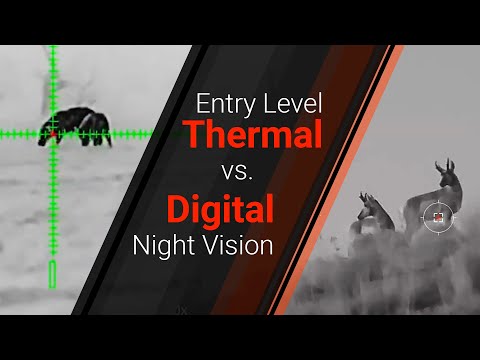
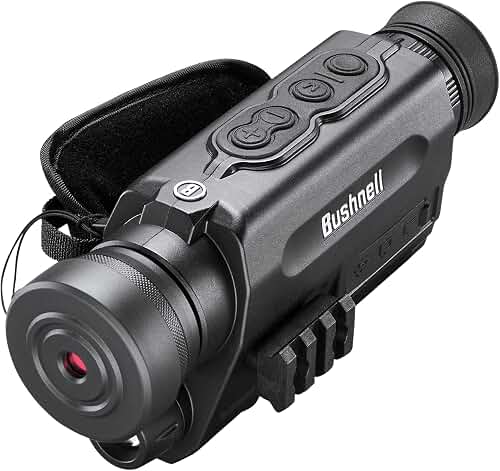
Digital night vision — the affordable stuff under $200 — works differently. It uses a CMOS sensor (basically a souped-up smartphone camera chip) paired with an infrared illuminator that floods the scene with invisible IR light.
The trade-off is real:
| Feature | Analog (Gen 3) | Digital |
|---|---|---|
| Image clarity | Stunning | Pixelated up close |
| Latency | Zero (real time) | Slight lag |
| Battery life | 40+ hours | 4–8 hours |
| Price | $3,000–$8,000+ | $150–$600 |
| IR signature | None | Visible to other NV users |
If you're hunting around other operators with night vision, your IR illuminator lights you up like a lighthouse to anyone else with a tube. Worth knowing.
How Thermal Imaging Actually Works (Seeing Heat Itself)
Thermal optics don't see light at all. They see temperature differences — specifically, infrared radiation emitted by anything warmer than absolute zero.
A modern thermal core works like this:
- A microbolometer sensor (usually 256x192 to 640x512 pixels) detects long-wave IR radiation
- Each pixel measures temperature differences as small as 0.05°C
- The processor maps those temperatures to a color palette — white-hot, black-hot, red-hot, or rainbow
- You see a heat map of the world in real time
> ### What Thermal CAN'T Do > > - See through glass (windows reflect IR like a mirror) > - Identify faces or read text — resolution isn't there > - See through water (water absorbs IR almost completely) > - Tell you what species the heat blob is at long range
The Head-to-Head: When Each Tool Wins
Thermal Imaging WINS at:
- Detection at distance — spotting a coyote at 600 yards in pitch black
- Cutting through cover — brush, fog, light rain, smoke
- Search-and-rescue — finding a lost child in dense woods at 3 a.m.
- Predator hunting — pigs, coyotes, raccoons all glow like neon signs
- Zero ambient light — no moon, no stars, no problem
Night Vision WINS at:
- Positive identification — "Is that my dog or a coyote?"
- Reading details — signs, faces, gear, license plates
- Navigation — walking through unfamiliar terrain without tripping
- Driving — many operators run NV behind the wheel on backroads
- Long battery missions — Gen 3 tubes sip power for 40+ hours
The Hybrid Truth: What Pros Actually Run
Here's the dirty secret nobody selling a single device wants you to know:
> Serious hunters, snipers, and operators run BOTH.
The playbook looks like this:
- Scout with thermal — sweep the landscape, locate any heat signature
- Identify with night vision — confirm what you're looking at before action
- Engage or move on — informed decision, zero guesswork
> ### Budget Reality Check > > A capable thermal monocular plus a decent digital NV scope can be assembled for under $1,200 total in 2026 — something that would have cost $15,000 a decade ago. The barrier to entry has collapsed.
Mission Profiles: Pick Your Setup by Use Case
Backyard / Property Watch
Best buy: Digital NV monocular ($150–$500) Why: You mostly need to identify intruders and confirm what's making noise. Detection range matters less when the threat is 40 yards away.Casual Hog or Coyote Hunting
Best buy: Entry-level thermal monocular ($400–$900) Why: Hogs are nocturnal, often in brush, and you need detection more than identification.Serious Predator Hunting
Best buy: Thermal scope + thermal scanner ($2,500–$6,000) Why: You're shooting at distance. You need detection AND aiming in the same package, plus a wider scanner to find targets between shots.Search-and-Rescue Volunteer
Best buy: Handheld thermal monocular ($500–$1,500) Why: Heat signatures cut through cover. A lost hiker glows from 300 yards out, even behind brush.Military, LEO, or Tactical Use
Best buy: PVS-14 or BNVD-style binocular + clip-on thermal ($4,000–$15,000+) Why: You need the gold standard for navigation, driving, shooting, and target ID — and a thermal overlay for detection.Common Mistakes Beginners Make (And How to Dodge Them)
MISTAKE #1: Buying based on "detection range" specs Marketing ranges are measured against a 1.8m human-sized heat source in ideal conditions. Real-world performance is often 50–70% of the spec sheet.
MISTAKE #2: Skipping the warranty Thermal sensors are delicate. A drop on concrete = a $400+ repair if you don't have coverage.
MISTAKE #3: Buying ultra-cheap Chinese knockoffs on Amazon The sub-$100 "night vision binoculars" are almost universally toys with a webcam and an IR LED. They will disappoint you within one night out.
MISTAKE #4: Ignoring eye relief and ergonomics A device you can't comfortably hold to your eye for 20 minutes is a device you won't use. Test in person if possible.
MISTAKE #5: Forgetting batteries and SD cards Most units ship with a single battery. You'll want three minimum for a serious outing, plus a fast charger.
The Bottom Line
Night vision and thermal imaging are not competitors. They're specialists.
- Need to find something? Thermal.
- Need to identify something? Night vision.
- Want to do both at the highest level? Run both.
Then, when you're ready to level up, add a night vision unit for identification — and you'll be running the same playbook as the pros.
> ### Your Next Step > > Whatever you choose, buy from a vendor with a return policy. Try the device in your actual environment within the first week. If it doesn't perform the way you expected, send it back — no shame, no second-guessing. Optical gear is intensely personal, and the best device is the one you'll actually carry.
Have a question about a specific model or use case? The NoctSpan Editorial Team reads every reader email and updates this guide quarterly based on what you tell us. We're in the field testing so you don't have to be.
Key Takeaways
- Choosing the right night vision vs thermal imaging difference means matching the key features to your specific needs and budget
- Read real customer reviews and check the return policy before you commit
- Also covers: thermal vs night vision
- Also covers: which is better thermal or night vision
- Also covers: IR vs thermal optics
- Compare value across models — the priciest option is not always the best fit