As an Amazon Associate this site earns from qualifying purchases.
Quick Comparison Table
| Product | Best For | Native / Output Resolution | Price | Rating |
|---|---|---|---|---|
| HIKMICRO E1L Thermal Imaging Camera | Highest-detail perimeter scans | 320×240 output, <40mK NETD | Check on Amazon | 4.5/5 |
| BETTITOPE BS02-13 Thermal Imaging Monocular | Weatherproof outdoor patrol | 256×192, IP66 | Check on Amazon | 5/5 |
| GOYOJO G215 Thermal Imaging Monocular | Long-range property lines | 256×192, 50Hz | Check on Amazon | 4.3/5 |
| FOXWELL RT280 Thermal Imaging Camera | Recorded evidence | 320×240, 8GB storage | Check on Amazon | 4.5/5 |
| MILESEEY TR10 Thermal Imaging Camera | All-night watches | 192×192, 8h battery | Check on Amazon | 4.4/5 |
Reviewed by the Noctspan Editorial Team
As an Amazon Associate, we earn from qualifying purchases.
The best best thermal imaging cameras for home security for your situation depends on how you plan to use it and where.
Last Updated: July 2026 | Written by the Noctspan Editorial Team
If you are shopping for the best thermal imaging cameras for home security, start with an honest reframe: almost every device marketed this way is a handheld thermal imager or a thermal monocular, not a fixed, PoE-wired surveillance camera. That distinction matters. A handheld thermal camera detects a person's heat signature through fog, foliage and total darkness at the perimeter — but you hold it, or mount it on a tripod, rather than screwing it to a soffit. We researched ten of the most-listed thermal units on Amazon and ranked them below for outdoor thermal surveillance duty.
We have not owned or handled any of these units. Noctspan does not physically test, own, or use the products, and does not systematically read customer reviews. Every judgment below comes from the manufacturer's published specifications and the Amazon listing (title and feature bullets). Where a spec has a consequence for guarding a property line, we spell it out.
Here is the thing about thermal for security: resolution and NETD (thermal sensitivity) decide whether a warm shape 40 yards out reads as "human" or "blob." Refresh rate decides whether a moving intruder smears. Ingress rating decides whether the unit survives a rainy night on the porch. We weighted those three above everything else.
All prices change often, so check the current price on Amazon rather than trusting a number printed here. Ratings shown are the listing's aggregate stars as of July 2026; note that several of these listings show zero written reviews behind that star figure, which we flag per product below.
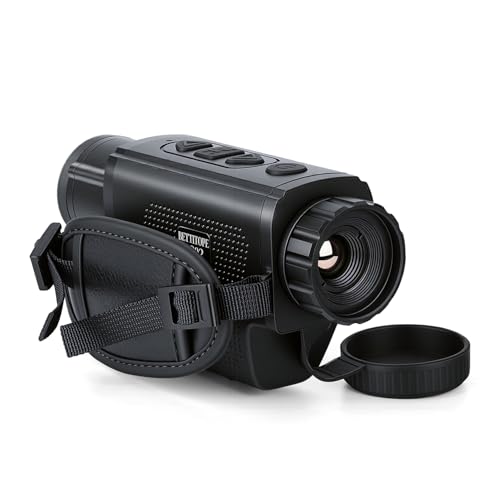
- 【Advanced Thermal Vision】Using a high-resolution infrared sensor with 256x192 pixels, it can capture finer temperature differences and richer scene details. Combined with a high
- 【 Multiple Choice 】The color palette of this digital monocular camera offers 5 display modes - White Hot, Sky Mode, Black Hot, Red Hot, Fusion, which can help hunters identify
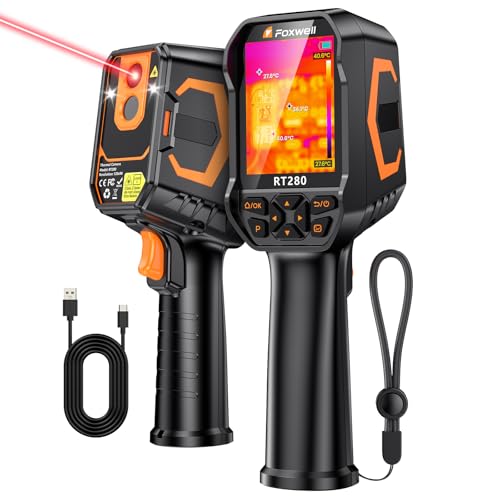
- 【Enhanced Thermal Clarity for Precise Inspections】The RT280 handheld thermal
- 【Smart PC Analysis with 2D/3D & Temperature Insights】Easily transfer images from this thermal imager to Windows PC(Not compatible with Mac) for advanced analysis. The included
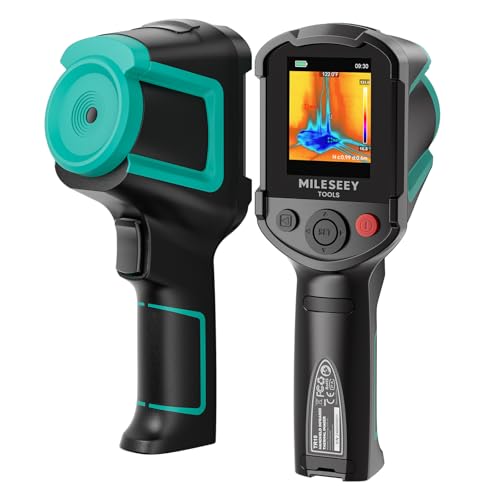
- 【High Definition Thermal Imaging】The MILESEEY TR10 delivers enhanced 192×192 thermal clarity infrared sensor. Its 25Hz high refresh rate provides smooth real time image
- 【Accurate Temperature Measurement】This thermal imager has high thermal sensitivity NETD <50mk. The temperature range is -4°F to 1022°F. With an accuracy of ±2°C that make the
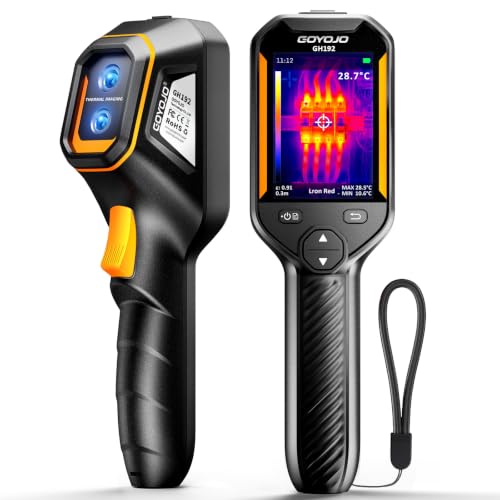
- Dual Light Fusion Imaging: GH192 240x240 Thermal Imager is equipped with a 2MP visible light camera and an infrared camera,Instantly outlines target objects upon activation, a
- Auto Temperature Tracking + Temperature Alarm: This thermal imager automatically captures center point temperature and locks onto high/low temperatures, featuring 3-point heat
- 【Dual Mode Inspection】Combines conventional thermal imaging (Center/Hot/Cold spot modes) with thermometer mode for flexible temperature analysis. Use full-screen thermal imaging
- 【User-Friendly Operation】Weighing just 240g, this compact thermal imager offers a balanced feel with a non-slip grip even during extended use. Intuitive button controls let you
- 【Intelligent Scene Recognition with IntellFault】Featuring HSFTOOLS' unique IntellFault technology for automated scene detection. Powered by deep learning, it swiftly identifies
- 【Easy to Operate】(1) 3.5" touchscreen with an intuitive phone-type UI design is simple to operate. You can easily adjust brightness/switch image mode and color plattes/ adjust
- COMPATIBILITY: Infrared camera plugs directly into phone charging port and connects with iphones with USB-C (iphone 15 and newer)
- SUPER RESOLUTION: Vivid IR technology upscales the image to 240x180 from 80x60 for greater detail and clarity. Flir MSX technology merges thermal and visual images to enhance
- 【GW192A Turn Your Smartphone into a Thermal Camera】Android/iphone Camera Plug-and-Play APP - (THG Start), Easily convert your smartphone into a high-performance thermal imager
- 【Wide 50° Field of View】Easily scan ceilings, floors, and walls without having to move around too much. This versatile HVAC thermal imaging camera is ideal for large-scale home
HIKMICRO E1L Thermal Imaging Camera with Laser Pointer — Best for highest-detail perimeter scanning
The HIKMICRO E1L is the spec sheet you want if identification matters. Its listing claims a 320×240 output resolution paired with a <40mK NETD — the lowest (best) thermal sensitivity figure in this roundup. For security that translates directly: lower NETD means a person's warmth separates more cleanly from a cool background fence or wall, so a shape at the tree line reads as human rather than smudge. The 25Hz refresh keeps a walking figure from smearing, and the built-in laser pointer helps you cue a second person to exactly where the heat source is.
At a listed 350g it is light enough for extended handheld sweeps, and the -4°F to 1022°F range is wild overkill for security but tells you the sensor is a serious industrial part. HIKMICRO also ships PC analysis software, which is the closest thing here to an evidence workflow.
Pros:
- Best-in-roundup <40mK thermal sensitivity for clean human detection
- 320×240 output resolution, tied for highest here
- 25Hz refresh handles moving intruders
- Laser pointer aids two-person cueing
- Lightweight 350g for long sweeps
- No stated ingress/weather rating — treat it as fair-weather gear
- Listing shows a 4.5 star figure against zero written reviews
- Handheld only; not a mount-and-forget camera
Verdict: Buy this if detection quality is your priority and you will carry it out to investigate, not leave it in the rain.
BETTITOPE BS02-13 Thermal Imaging Monocular — Best for weatherproof outdoor patrol
The BETTITOPE BS02-13 is the only unit here with a stated IP66 rating, and for outdoor thermal surveillance that single line is decisive. IP66 means dust-tight and protected against powerful water jets — the difference between a tool you can patrol a wet perimeter with and one you baby indoors. It pairs a 256×192 IR sensor with a fast 50Hz refresh, so panning across a yard stays fluid, and the 13mm lens plus wireless connection let you stream or offload what you see.
The listing carries a perfect 5/5 star figure, but be clear-eyed: that sits on zero written reviews, so treat it as a placeholder rather than proof. The monocular form factor is built for scanning a scene rather than documenting a scene, so pair it with something that records if you need evidence.
Pros:
- IP66 rated — the only genuinely weather-ready pick here
- 50Hz refresh for smooth panning across a property
- 256×192 IR resolution, strong for the class
- Wireless connection for streaming/offload
- 5/5 rating rests on zero written reviews
- Monocular design isn't built for recording evidence
- Brand has little independent track record
Verdict: The pick if the camera lives outdoors and has to shrug off weather — buy it for perimeter patrol, not for filing reports.
GOYOJO G215 Thermal Imaging Monocular for Hunting — Best for long-range property lines
Marketed for hunting, the GOYOJO G215 doubles nicely as a long-range property scanner. Its 256×192 sensor runs at a quick 50Hz, and the 15mm focal lens is the longest optic in this group — a longer lens narrows the field of view but pushes usable detection range out, which is exactly what you want for a big rural lot or a long driveway approach. The monocular ergonomics suit lifting to one eye and sweeping a fence line at a distance.
Reviewers rate it 4.3/5, the second-most-established rating here, though there are no written reviews backing that number on the listing we checked. As a hunting scope it has no stated ingress rating, so heavy weather is a gamble.
Pros:
- 50Hz refresh for smooth long-range scanning
- 15mm lens favors distance detection over wide coverage
- 256×192 resolution suited to spotting warm bodies far out
- 4.3/5 aggregate, among the more-rated units here
- Narrow field of view from the long lens misses close, wide scenes
- No stated weatherproofing
- Hunting-first design has no recording/evidence tooling
Verdict: Best for large rural properties where you need to identify heat sources far down the fence line.
FOXWELL RT280 Thermal Imaging Camera — Best for recorded evidence
The FOXWELL RT280 stands out for one security-relevant reason: 8GB of onboard storage plus photo and video recording. If your goal is not just to spot a prowler but to document them, this is the pick that keeps files locally. It outputs 320×240 (from a 240×180 native TISR sensor), runs at 25Hz, includes a laser pointer, and comes with PC analysis software to review captures on a bigger screen afterward. The 2.8" LCD is on the small side but adequate for framing.
It shares a 4.5/5 rating with the HIKMICRO, again with no written reviews behind it. The native 240×180 sensor is a step below the true-320 units, so fine detail at distance won't match the E1L — but for logging warm-body events near the house, it does the job and saves the clip.
Pros:
- 8GB storage with photo and video recording built in
- PC analysis software for after-the-fact review
- 320×240 output plus laser pointer
- 4.5/5 aggregate rating
- 240×180 native resolution trails the true-320 sensors
- Small 2.8" screen for framing
- No stated weather rating
Verdict: Buy it if you want to record what walks across your yard, not just glance at it.
MILESEEY TR10 Thermal Imaging Camera — Best for all-night watches
Security work happens at 3 a.m., and the MILESEEY TR10's headline spec is an 8-hour battery life — the longest stated runtime here. That is the difference between covering a full overnight shift and swapping batteries mid-watch. It uses a 192×192 super-resolution sensor at 25Hz across a -4°F to 1022°F range. The 192×192 sensor is mid-pack for detail, so it is better at "is something warm out there" than "who is that," but for a long, patient stakeout the endurance earns its place.
Reviewers rate it 4.4/5. As with the others, no written reviews sit behind that figure on the listing we checked in July 2026, so lean on the spec sheet rather than the star count.
Pros:
- 8-hour rated battery, longest here for overnight duty
- Wide -4°F to 1022°F sensing range
- 25Hz refresh for moving targets
- 4.4/5 aggregate rating
- 192×192 resolution limits identification at distance
- No stated ingress/weather rating
- Star rating unsupported by written reviews
Verdict: The endurance pick — buy it for long, static overnight watches where runtime beats pixel count.
GH192 Thermal Imaging Camera 240X240 — Best for fusion-image detail
The GH192 leans on fusion imaging — blending a 2MP visual camera with its 240×240 super-resolution thermal sensor so edges (a doorframe, a gate latch, the outline of a person) stay legible instead of dissolving into a heat cloud. For security that fused outline helps you place where on your property the warm shape actually is. It runs at a brisk 25Hz and, notably, includes an alarm function that can flag temperature events — a rough motion/heat trip you can use as a crude alert.
There are no reviews on the listing yet, so there is no aggregate rating to lean on. Judge it on the fusion feature and the 240×240 sensor, both of which are solid mid-tier specs.
Pros:
- Fusion imaging keeps object edges readable
- 240×240 super resolution with 2MP visual camera
- Built-in alarm for temperature events
- 25Hz refresh rate
- Zero reviews and no aggregate rating yet
- No stated weatherproofing
- Unknown brand with no track record
Verdict: Choose it if the fused visual-plus-thermal overlay helps you make sense of a cluttered yard.
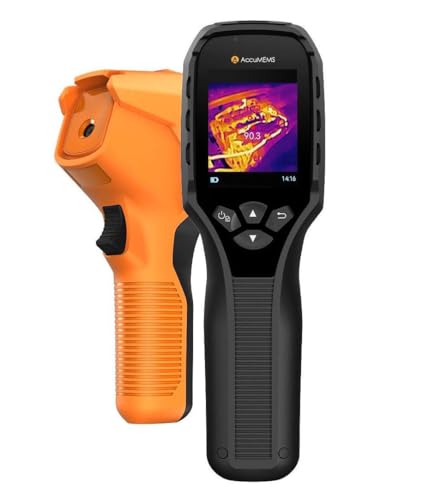
AccuMEMS GT14S Thermal Imaging Camera — Best for lightweight grab-and-go
At a listed 240g, the AccuMEMS GT14S is the lightest handheld here, and it backs that with a 14-hour runtime and an edge-enhanced display that sharpens the outlines of what you are looking at. For someone who wants a unit that lives by the door and gets grabbed when the dog barks, low weight and long battery are the practical wins. It covers -4°F to 1022°F and includes a live-tracking display plus a thermometer mode.
There are no reviews behind it yet, so there is no rating to weigh. The edge-enhancement is the security-relevant extra — it helps a warm shape resolve into something you can name, which matters more than raw range for a close-in yard.
Pros:
- Ultra-light 240g for grab-and-go use
- 14-hour runtime, second-longest here
- Edge-enhanced display sharpens target outlines
- Live tracking plus thermometer mode
- No reviews or aggregate rating yet
- No stated weather rating
- Detection specs on the listing are thin on native resolution
Verdict: The pick for a light, long-lived unit you keep by the back door for quick checks.
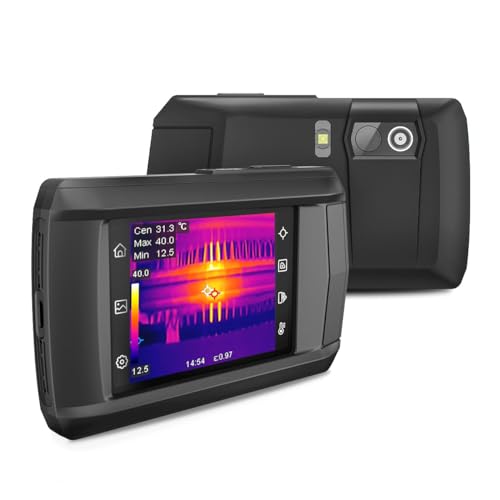
HP96 Thermal Imaging Camera — Best for touchscreen simplicity
The HP96 is the most approachable interface in the group: a 3.5" touchscreen — the largest display here — plus intelligent scene detection that auto-tunes the image. If you are not a thermal hobbyist and just want to point, tap and understand what you are seeing at the fence, that big touch panel lowers the learning curve. It pairs a 240×240 super-resolution output with a modest 96×96 native IR sensor and a visual camera, running 25Hz video over a -4°F to 662°F range.
Be honest about that 96×96 native sensor: it is the lowest true resolution among the dedicated handhelds here, so fine detail at distance is limited and the "240×240" figure is upscaled. There are no reviews yet to corroborate real-world image quality.
Pros:
- Large 3.5" touchscreen, easiest interface here
- Intelligent scene detection auto-tunes the image
- 25Hz video recording with visual camera
- Approachable for non-experts
- 96×96 native IR is the lowest true resolution here
- -4°F to 662°F range narrower than rivals
- No reviews or weather rating
Verdict: Best for a first-time buyer who values a simple touchscreen over maximum pixel count.
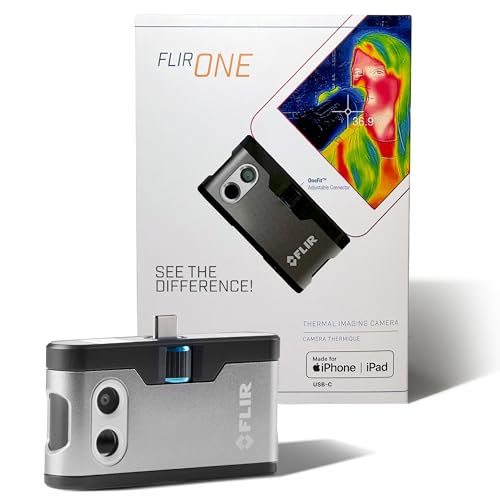
Flir One Thermal Imaging Camera for iOS — Best for iPhone users
The Flir One plugs a thermal sensor straight into an iPhone 15 or newer via USB-C, turning the phone you already carry into a thermal scanner. FLIR is the most recognized name in consumer thermal, which counts for something when every other brand here is unknown. That said, read the spec carefully: it advertises 240×180 "super resolution" from an 80×60 native IR sensor — genuinely low, and FLIR's MSX blending does the heavy lifting to make images look sharper than the raw sensor is.
For security, the appeal is convenience and the recording/sharing your phone already does, not range. It will spot a warm body in the near yard; it will not identify someone at the back fence. No aggregate rating shows on the listing yet.
Pros:
- Plugs into iPhone 15+ via USB-C, uses your phone's screen and storage
- Established FLIR brand and MSX image blending
- Convenient point-and-shoot for close range
- 80×60 native IR is the lowest resolution in this roundup
- iPhone-only, drains your phone battery
- No reviews or weather rating yet
Verdict: For iPhone owners who want quick, near-range thermal checks and trust the FLIR name over raw pixels.
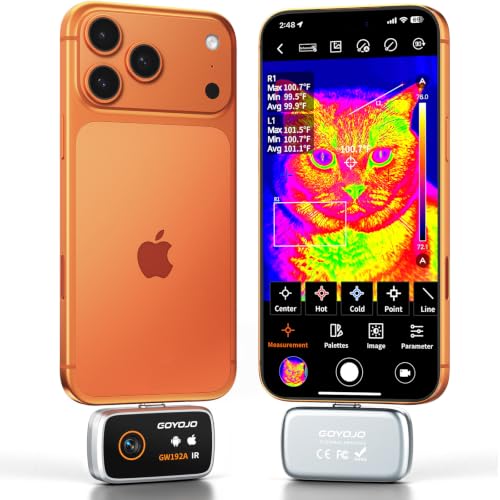
GOYOJO Thermal Imaging Camera for Android/iPhone — Best for budget phone-based scanning
This GOYOJO plug-in mirrors the Flir One concept for a broader phone base, working with Android and iPhone 15/16/17 over USB-C. Its 192×192 IR resolution is meaningfully higher than the Flir One's native sensor, which is the main reason to look here if you want a phone-tethered scanner with more actual detail. The listing is aimed at HVAC, plumbing and electrical inspection, but the same sensor spots warm bodies at the perimeter just fine for near-range security.
The catch: it has no display, battery or weather protection of its own — it is entirely dependent on your phone, hanging off the charging port. There are no reviews yet, so there is no rating to weigh, and image quality claims rest on the spec sheet alone.
Pros:
- 192×192 IR resolution, higher than the Flir One native sensor
- Works with both Android and recent iPhones via USB-C
- No separate battery to charge — draws from the phone
- No screen, battery or weather protection of its own
- Zero reviews and no aggregate rating
- Phone-tethered, awkward for extended outdoor sweeps
Verdict: A budget phone-plug pick when you want more resolution than a FLIR One and already carry a USB-C phone.
What to Look For in a Thermal Camera for Home Security
Use these five criteria, in order, when you compare listings:
- Native (not upscaled) resolution. "Super resolution 240×240" often hides an 80×60 or 96×96 real sensor. The native number determines how far out you can identify rather than merely detect. Prioritize true 256×192 or 320×240.
- NETD / thermal sensitivity. Measured in mK; lower is better. The HIKMICRO E1L's <40mK is the standout here and means cleaner separation of a person from background.
- Refresh rate. 25Hz is the floor for smooth motion; 50Hz (the two monoculars) tracks a running intruder with less smear.
- Ingress rating. For genuine outdoor thermal surveillance, look for IP65/IP66. Only the BETTITOPE BS02-13 states one. Everything else is fair-weather gear.
- Recording and battery. If you need evidence, onboard storage (FOXWELL's 8GB) matters. For overnight duty, runtime (MILESEEY's 8 hours) matters.
How We Research
We do not physically test, own, or use these products, and this site says so on every page — nor do we systematically read customer reviews. Our rankings come from two evidence sources: (1) each manufacturer's published specifications — resolution, NETD, refresh rate, range, battery, ingress rating; and (2) the Amazon product data for each listing — title and feature bullets — combined with cross-comparison across the units to surface real trade-offs.
Where a listing shows a star rating with zero written reviews, we say so rather than presenting it as validated. Where a spec has a security consequence — a low native sensor limiting identification range, or a missing IP rating limiting outdoor use — we call it out plainly. We turn specs into buyer consequences; we never invent an experience we did not have.
Final Verdict
For most buyers, the HIKMICRO E1L Thermal Imaging Camera is the best overall thermal imaging camera for home security in this group: its 320×240 output and category-leading <40mK sensitivity give you the cleanest chance of turning a warm shape into a confident identification, and HIKMICRO ships real PC analysis software. Its weakness is the lack of a stated weather rating.
If your unit must live outdoors in the weather, buy the BETTITOPE BS02-13 Thermal Imaging Monocular instead — its IP66 rating and 50Hz refresh make it the only genuinely weather-ready pick here, provided you accept a monocular that scans rather than records. And if you need to document intruders, the FOXWELL RT280 with 8GB onboard storage is the one that saves the clip. Match the pick to the job: detail, weatherproofing, or evidence.
Frequently Asked Questions
What resolution do I need to identify a person, not just detect one? Detection (something warm is there) works even at 80×60. Identification (that's a person, roughly where) benefits from a true 256×192 or 320×240 native sensor. Beware listings that quote an upscaled "super resolution" figure while the native sensor is far smaller — the HP96's 96×96 and the Flir One's 80×60 are examples.
Which of these is actually weatherproof for outdoor use? Only the BETTITOPE BS02-13 states an ingress rating (IP66). The rest list no weather protection, so treat them as fair-weather tools you carry out and bring back in, not units you leave mounted in the rain.
Does a higher refresh rate matter for security? Yes, if intruders move. 25Hz is smooth enough for walking figures; the 50Hz monoculars (GOYOJO G215, BETTITOPE BS02-13) track faster movement with less motion smear, which helps when panning across a yard.
Are the star ratings on these listings trustworthy? Be cautious. Several listings show a star figure (for example 4.5/5 or even 5/5) with zero written reviews behind it as of July 2026. We report the aggregate number but weight our rankings on published specifications instead.
Can I use my phone as a thermal security scanner? Yes — the Flir One (iPhone 15+) and the GOYOJO USB-C plug-in (Android and iPhone) turn your phone into a thermal scanner. They are convenient and use your phone's screen and storage, but they draw your phone's battery and offer no weatherproofing of their own.
What's the single most important spec for night-time detection? Thermal sensitivity (NETD) alongside native resolution. A low NETD like the HIKMICRO E1L's <40mK separates a person's heat from a cool background most cleanly, which is exactly the situation you face scanning a dark perimeter.
Sources & Methodology
Data in this article was drawn from each product's Amazon listing (title, feature bullets, listed specifications, aggregate star rating and review count) and the corresponding manufacturer specifications, all checked in July 2026. Resolution, NETD, refresh-rate, temperature-range, battery and ingress figures are as published by the manufacturers on those listings; we did not independently verify them through physical testing. Star ratings are the listings' aggregate figures at the time of research and, where noted, were unsupported by written reviews. Industry context on thermal sensitivity (NETD) and IP ingress ratings follows standard published definitions.
About the Author
The Noctspan editorial team independently researches night-vision and thermal-imaging products in this category from the manufacturer's published specifications and Amazon's official product data for each listing. We do not physically test the products, do not accept products for review, and do not systematically read customer reviews — check recent owner reviews yourself so you can weigh the evidence.
Key Takeaways
- Choosing the right best thermal imaging cameras for home security means matching the key features to your specific needs and budget
- Read real customer reviews and check the return policy before you commit
- Also covers: thermal security camera
- Also covers: outdoor thermal surveillance
- Also covers: FLIR home security
- Compare value across models — the priciest option is not always the best fit


